
In September 2026, Turkey's Capital Markets Board (SPK) suspended trading in the funds of seven asset managers and ordered 131 funds into liquidation. Those funds hold roughly TRY 890 billion in assets and 455,758 investors, about a tenth of the Turkish investment fund sector.
This did not happen overnight. A structure built up over months unwound in a matter of days. This article walks through the crisis in five questions: How was the loop built? Why did it turn into a run? What did investors lose? How did it reach the index? And how do the new SPK rules break the loop?
Our aim is to explain what happened in plain language, with data. Investigations are ongoing; no allegation in this article has been confirmed by a court.
In Brief
- Mechanism: Some funds built very large positions in stocks with a small free float. Fund buying lifted the price, the price lifted the fund's return, and the return attracted new money.
- Break: When inflows stopped, the only buyer holding up the price disappeared. Funds promising redemption within days were left holding stocks that could not be sold.
- Outcome: Five stocks closed limit-down for eight consecutive sessions and lost roughly 57%. BIST 100 fell 7.1% in ten days.
- Regulation: SPK's guideline of 28 August 2026 targets each link in the loop. The rules did not create the crisis; they stopped it from growing.
What Happened: A Short Timeline
| Date | Event |
|---|---|
| Q4 2025 | SPK identifies price movements in low free-float stocks, driven by certain funds, that economic fundamentals cannot explain. |
| 2 December 2025 | The Financial Stability Committee takes up the issue; SPK forms a working group the next day. |
| 18 December 2025 | The qualified-investor threshold for hedge funds is raised from TRY 1 million to TRY 10 million. |
| June 2026 | MSCI warns about possible coordinated trading and free-float calculations in Turkey. |
| 28 August 2026 | SPK publishes comprehensive amendments to the Investment Funds Guideline. |
| 15 September 2026 | Pusula Portföy discloses difficulties meeting redemptions. |
| 16 September 2026 | Tera Portföy announces a default on redemptions in one money market fund and one equity fund. BIST 100 closes down 5.54%. |
| 17 September 2026 | SPK suspends subscriptions and redemptions on TEFAS for all funds of seven asset managers and orders 131 funds into liquidation. |
| 21 September 2026 | The liquidation period is extended from three to six months. |
1. How Does the Manipulation Work?
A fund's return is only as real as the prices of the stocks it holds. When the fund itself sets those prices, the return exists only on paper.
Starting point: a thinly traded stock
Not all of a company's shares trade on the exchange. Most are usually held by controlling shareholders. The portion that actually trades is the free float. A stock with a small free float and limited daily volume can make large price moves under modest buying pressure. That is where the loop starts.
A self-feeding loop
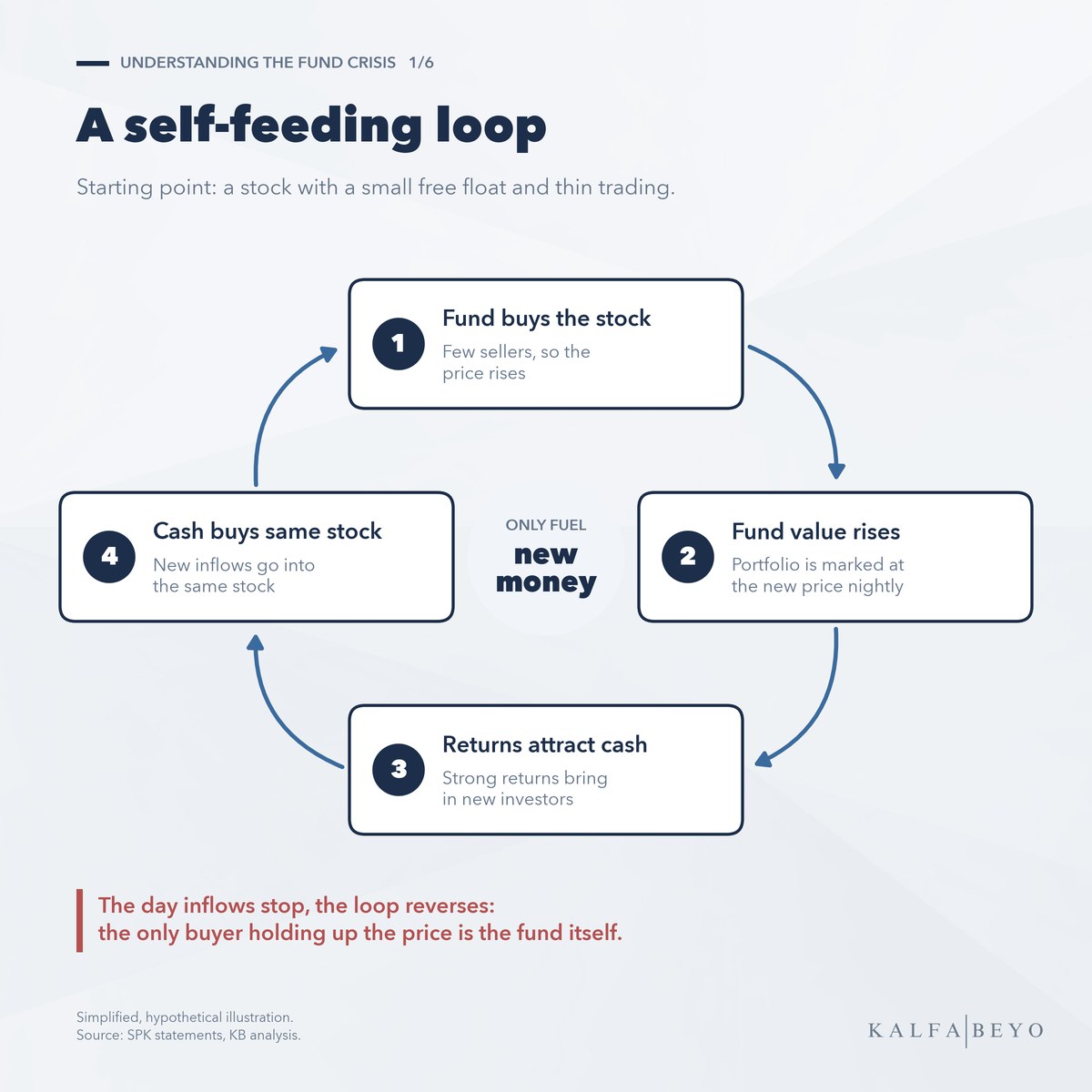
The loop repeats in four steps:
- The fund buys the stock. Sellers are scarce, so the price rises.
- The fund's value rises. The portfolio is marked at the new price every evening, and the unit price rises with it.
- Returns attract cash. Strong returns bring in new investors.
- The cash buys the same stock. New inflows go back into the same stock, and the price rises again.
The loop has one requirement: more new money every day than the day before.
A simple example
Company A has 100 million shares. Only 20 million actually trade. Daily volume is 200,000 shares.
The fund absorbs a large share of the sell orders every day. A few months later it owns 40% of the free float, or 8 million shares. The screen shows a large gain.
But selling that position would take 40 trading days even if the fund captured the entire daily volume. In practice, the first large sell order pushes the price down. The gain on the screen is not a gain that can be sold.
Traces in the real market
Public disclosures show traces of this structure:
- As of 1 September, Tera funds held 10.20% of Destek Finans Faktoring's (DSTKF) capital, equal to 39.41% of its free float.
- Pusula funds held 38.67% of Gündoğdu Gıda's capital and 25.59% of Katılımevim's.
- DSTKF rose from roughly TRY 50 in February 2025 to TRY 3,920 in July 2026: about 78x in 17 months.
The second channel: money market funds
According to SPK, the risk did not come from equity funds alone. Money market funds and equity hedge funds also created systemic risk through unsecured borrowing between related parties.
Money market funds are sold as the most liquid, lowest-risk product on the shelf. Channelling their assets to group companies without collateral turns the safest-looking product into a funding source for the loop.
2. Why Was the Run Inevitable?
A fund is only as liquid as its least liquid asset. If a fund promises redemption within days but holds stocks that would take months to sell, a run is not a possibility. It is a matter of timing.
The liquidity mismatch
The problem is a liquidity mismatch: the fund's obligations are short-term, while its assets take a long time to turn into cash.
A simple example: the fund's TRY 100 portfolio holds TRY 20 in cash and liquid assets and TRY 80 in thinly traded stocks. Redemption takes a few business days.
- The first 20% to leave are paid in full, from cash, at the last published price.
- To pay the next wave, the fund must sell stock. There are no buyers; the price hits limit-down.
- The unit price falls. Those still inside see that waiting works against them.
- Everyone tries to leave at once.
Not panic, but rational behaviour
A run does not require panic. Rational behaviour is enough: the first to leave get everything, the last get what remains. For every investor who sees this, the sensible move is to leave as early as possible. Panic does not start a run. The gap between asset liquidity and the redemption promise starts it; panic only accelerates it.
What happened in September
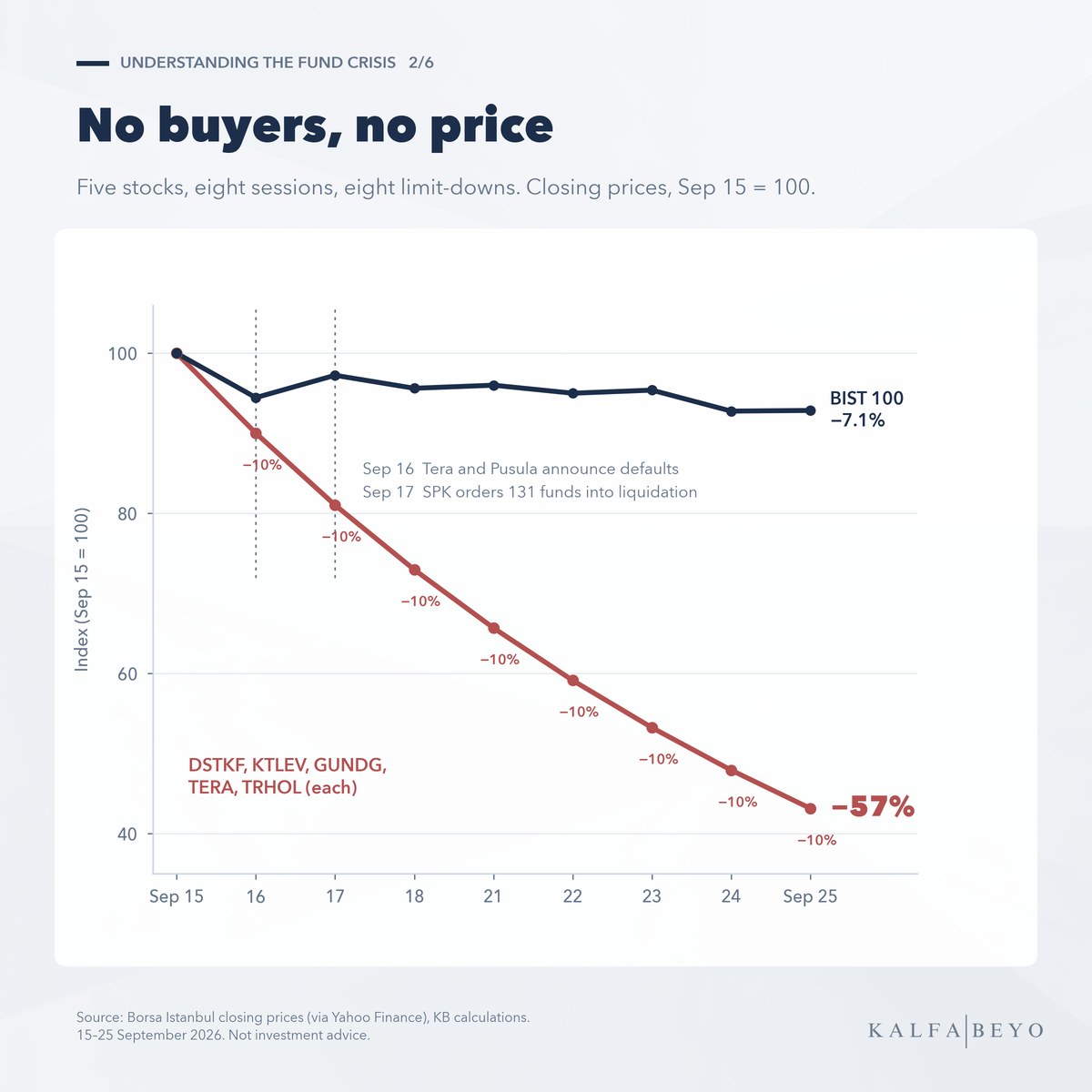
The timeline followed that sequence. On 15 September, Pusula Portföy disclosed redemption difficulties. On 16 September, Tera Portföy announced a default in one money market fund and one equity fund. The same day, six hedge funds moved to monthly pricing, with payment deferred to the 10th business day after valuation. On 17 September, SPK suspended trading in the funds.
Prices confirm the picture. Between 16 and 25 September, DSTKF, KTLEV, GUNDG, TERA and TRHOL each closed limit-down for eight consecutive sessions. The cumulative loss was roughly 57%. A limit-down streak does not mean there are many sellers. It means there are no buyers.
3. How Were Investors Affected?
The gap between the fund value on the screen and the amount an investor will actually receive is the real cost of this crisis.
Three groups of investors
Not every investor was affected the same way:
- Early leavers: paid at an inflated unit price, from the fund's liquid assets. The excess they received came out of the share of those who stayed.
- Investors inside at the freeze: their money is in liquidation for up to six months. They will receive what the assets can be sold for, not the last published unit price.
- Direct holders of the stocks involved: through an eight-session limit-down streak, they had no exit.
Screen value is not realizable value
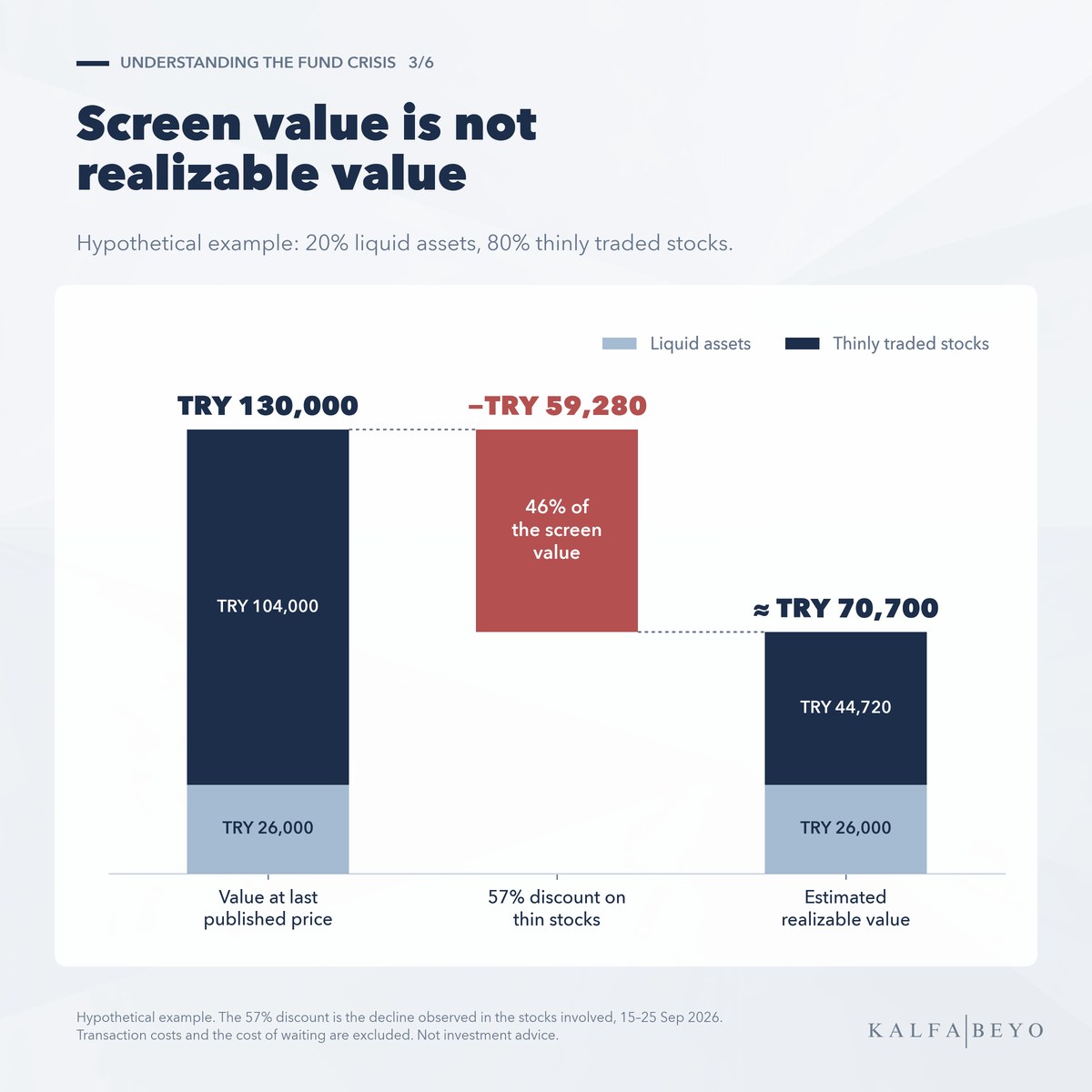
A hypothetical example for the second group:
- Account value at the last published price: TRY 130,000
- Portfolio: 20% liquid, 80% thinly traded stocks
- If those stocks are sold at the 57% decline seen during the crisis week:
- Liquid portion: TRY 26,000
- Stock portion: TRY 104,000 × 0.43 = TRY 44,720
- Estimated realizable value: roughly TRY 70,700
In this example, about 46% of the value on the screen has no sellable counterpart. Transaction costs and the opportunity cost of waiting six months in a high-rate environment are not included.
How the liquidation works
İşbank is liquidating the Tera funds; Ziraat Bank is handling the funds of the other six managers. The banks take control of fund assets, reconcile pending claims and liabilities, and sell the assets with market depth in mind. Payments are expected to be made in stages, pro rata, as assets are sold.
A unit price is an estimate of a fund's value, not a guarantee. That estimate rests on the assumption that the portfolio can be sold at that price.
4. How Does Manipulation Reach the Index?
A manipulated stock does not only hurt its own shareholders. Once it enters an index, it turns everyone who tracks that index into a buyer at the artificial price. The effect works in three stages.
Entry
The inflated price inflates market capitalisation. The stock enters indices such as BIST 30 or BIST 100. Index funds and benchmarked portfolios must buy it in proportion to its weight. A second, entirely legal buyer joins the loop.
Weight
Index weights are calculated on free-float shares. When shares held by related funds are counted as "free float", the stock looks more liquid and heavier than it is. MSCI warned about this in June 2026 and said it expects tangible progress before its November 2026 index review.
Exit
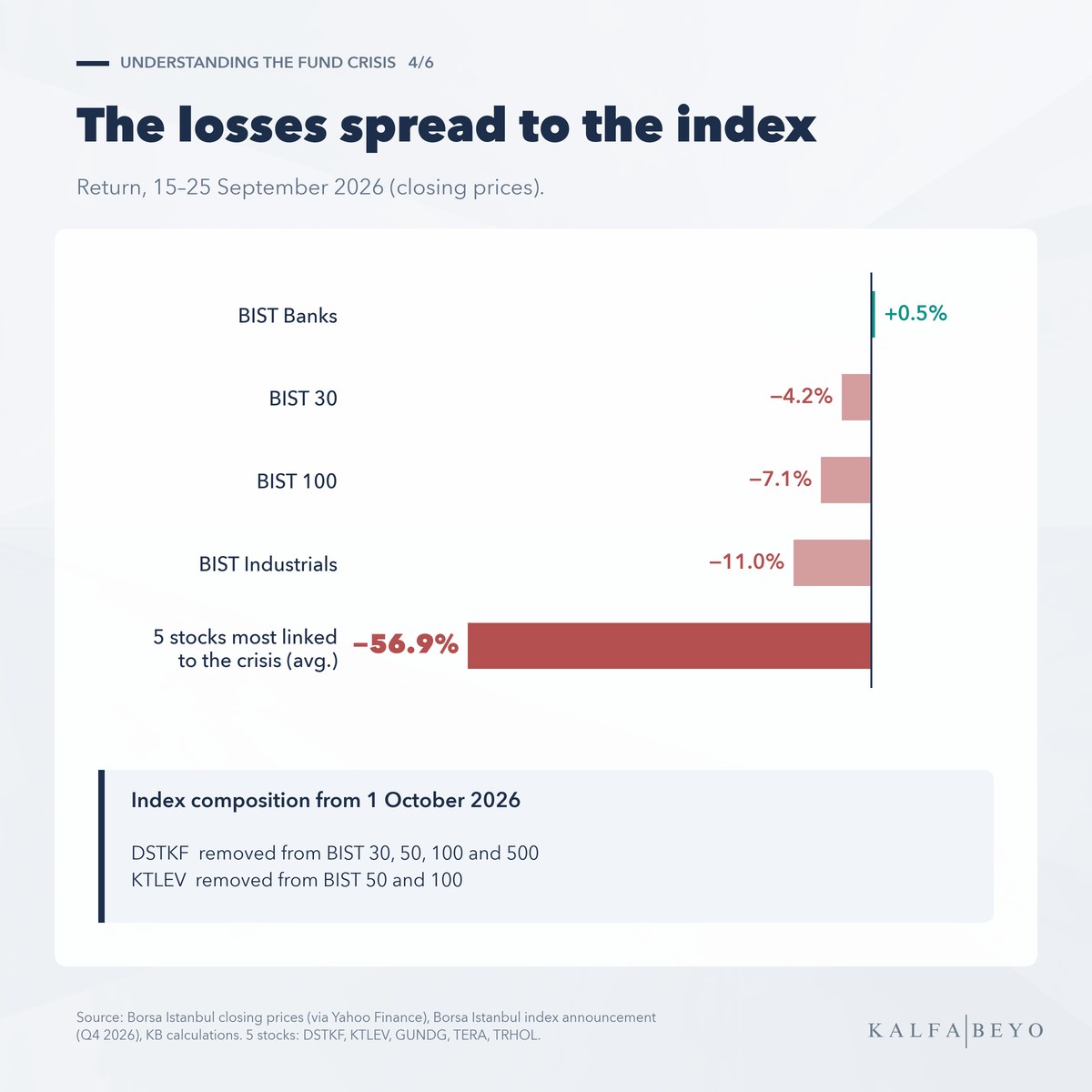
When the price collapses, the index spreads the loss across all of its investors:
- 16 September: BIST 100 fell 5.54%; a market-wide circuit breaker was triggered.
- 15–25 September: BIST 100 fell 7.1%, BIST 30 4.2% and BIST Industrials 11.0%. The five stocks most associated with the crisis lost 57% on average.
- 1 October 2026: DSTKF was removed from BIST 30, 50, 100 and 500; KTLEV was removed from BIST 50 and 100.
The country dimension
Foreign investors usually access Turkey through an index. Every question about index integrity feeds directly into the country risk premium. An index is the market's shared yardstick. Every artificial price inside it mismeasures everyone's performance, risk and cost.
5. Why SPK Made the Right Call
The SPK rules of 28 August did not create the crisis. They stopped it from growing.
The criticism and the answer
The criticism goes like this: new rules were announced, three weeks later the funds collapsed, so the rules are to blame.
That reading confuses cause with effect. A structure that needs fresh inflows every day to hold up its prices is already underwater at realizable value. The rules did not create that hole. They stopped it from growing with every new investor.
One rule for every link in the loop
The amendments to the Investment Funds Guideline target each link in the loop:
| Link in the loop | New rule |
|---|---|
| Concentration in thin stocks | In a stock outside BIST 30, a single hedge fund may hold at most 2–8% of the free-float shares. The cap for all funds of the same asset manager is 4–16%. |
| Buying that feeds the loop | Existing positions above the cap cannot be increased; compliance is phased in by the end of 2026. |
| Money market funds funding group companies | At least 10% of the portfolio in government securities, with new limits on reverse repo and collateral. |
| Unaccountable decisions | Any position above 5% of fund size requires a documented research file, kept for five years. Every fund must have at least two portfolio managers. |
| Retail access | The qualified-investor threshold for hedge funds rose from TRY 1 million to TRY 10 million. |
The concentration cap is tiered by the company's free-float ratio. For example, in a company with a 40% free float, all funds of one manager combined may hold at most 12% of the free float, or 4.8% of total capital. Public disclosures showed Pusula funds holding 38.67% of Gündoğdu Gıda's capital.
The timing criticism
The criticism on timing is the stronger argument. SPK says it identified unusual price movements in the last quarter of 2025; the comprehensive guideline arrived in August 2026. SPK attributes the gap to technical consultation and infrastructure work.
But a well-designed rule arriving late does not make it the wrong rule. In the interim, the qualified-investor threshold was raised, the TEFAS infrastructure was overhauled and valuation rules were tightened.
The complementary step: an accurate free float
The rule set has a complement on the index side: removing from free float the shares held through funds by parties already classified as non-free-float. SPK has introduced a framework in this direction as well.
It matters because BIST 30 stocks are exempt from the concentration caps. What stops index membership from being bought with an artificial price is an accurate free-float figure.
Good regulation does not eliminate risk. It prevents risk from growing out of sight. The 28 August guideline does exactly that.
6. Before You Invest in a Fund: Five Questions
A fund's unit price is like the asking price of a house: until a buyer shows up, it is only an estimate. The most practical lesson from this crisis is to look past the return and ask where it comes from.
- How quickly can the fund turn into cash? The redemption period is a few days. Does the daily trading volume of its stocks fit that window?
- How concentrated is the portfolio? What share of the portfolio do the top five positions represent? And what share of each company's free float?
- Are there related parties? Do the portfolio companies have ownership, underwriting or lending ties with the group that manages the fund?
- Can the return be explained? How far does the return deviate from peer funds and the index? Is there a concrete source for that gap?
- What is inside the money market fund? Government securities and deposits, or debt issued by related companies?
Most of the answers are public: portfolio breakdowns on TEFAS, monthly fund reports on KAP, and the fund prospectus.
Conclusion
There is no complex financial product at the centre of this crisis. There is a basic principle: an asset is worth what you can sell it for. A structure whose price is held up by a single buyer, whose returns depend on new inflows, and whose redemption promise exceeds the liquidity of its assets will unwind sooner or later.
A high return is not a warning sign on its own. An unexplained high return is.
Sources
- SPK, Statement on the Investment Funds Guideline amendment process (Turkish)
- Euronews, Turkey arrests Tera chairman as fund probe affects 450,000 investors
- Euronews Türkçe, What exactly happened in the Turkish fund scandal? (Turkish)
- Bloomberg HT, SPK puts the brakes on hedge funds (Turkish)
- CNBC-e, Decoding the SPK fund regulation (Turkish)
- Türkiye Today, MSCI sets November test for Istanbul stock exchange reforms
- Price data: Borsa Istanbul closing prices; calculations by KB.
Investigations are ongoing; no allegation has been confirmed by a court. This article is for information only and is not investment advice.